Prosthetic Drills Buyer's Guide: From Specs to Production Floor
By Marco Silva • 27th Feb
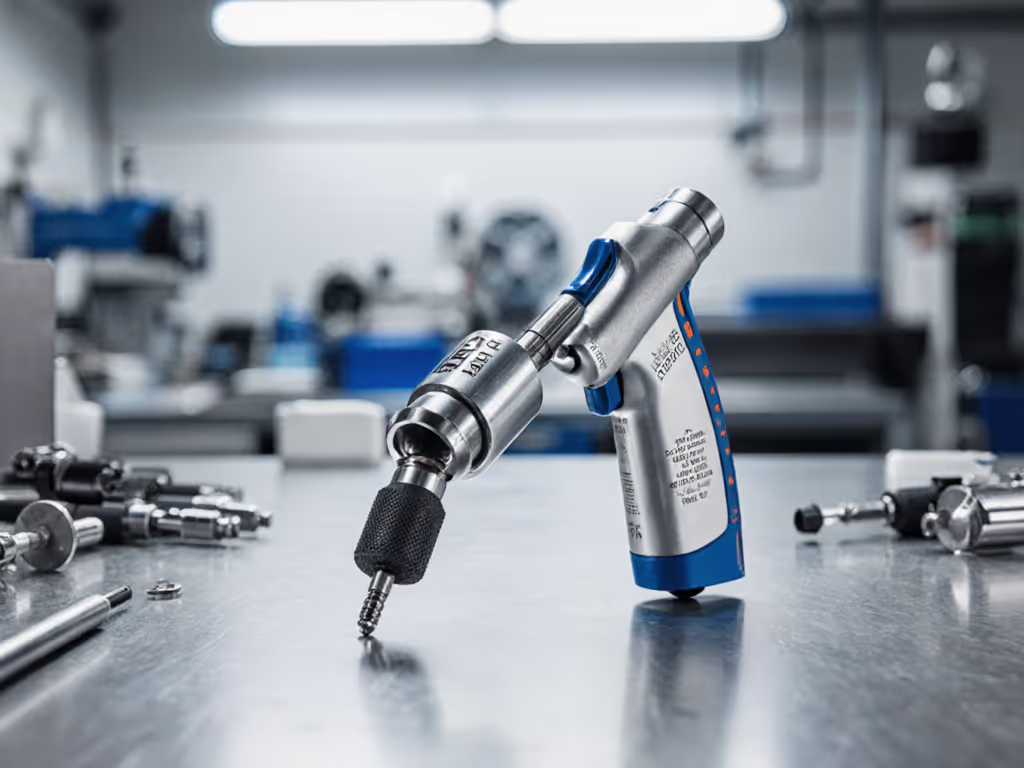
Prosthetic manufacturing drills and medical device production tools represent a unique category (precision instruments designed to drill bone, implants, and composites with accuracy measured in tenths of a millimeter and fatigue tolerance measured across a full shift). Unlike consumer or trade applications, prosthetic fabrication demands repeatability under load, thermal stability, and ergonomic control that directly affect implant seating, screw torque consistency, and operator safety. Yet many teams struggle to translate catalog specifications into floor-ready performance, leaving capacity on the table and operator fatigue unaddressed.
The Problem: Precision Without Clarity
Prosthetic manufacturing teams face a persistent tension. On paper, drills advertise motor speeds, torque ratings, and cutting-force thresholds. In the shop, the question remains: Which drill will drill clean osteotomy channels at target depth, shift after shift, without thermal drift or operator pain?
Several cascading pain points emerge:
Specification inflation. Manufacturer datasheets cite maximum torque and no-load RPM, but these figures rarely predict real-world output under the sustained, moderate loads of prosthetic drilling. A study examining bone drilling across multiple materials and speeds confirmed that torque drops significantly once cutting starts (maximum average torque values fell from 41.2 N·mm down to 24.2 N·mm in bovine bone samples as spindle speed increased), and similar reductions occurred in porcine and synthetic specimens. Marketing materials seldom emphasize this reality. [2]
Depth and dimension confusion. Drill catalogs specify nominal depths and diameters, but the actual osteotomy (bone bed) created is often 1 mm deeper than the visual depth marking suggests, a fact confirmed in surgical implant documentation. [1] [5] Teams without clear depth-gauge protocols drill inconsistent beds, forcing surgeons or assembly lines to compensate with manual checks and rework, a silent productivity drain.
Vibration and thermal instability. As spindle speed increases, vibration amplitude on bone samples increases considerably across all bone types. [2] Unchecked vibration translates to operator fatigue, reduced accuracy at the chuck, and accelerated tool wear. Temperature rise during extended drilling cycles can cause dimensional drift in composite or acrylic prosthetic components, yet thermal management is rarely a headline spec. For a deeper look at how thermal systems impact sustained performance, see our drill motor cooling guide.
Ergonomic blind spots. Many teams select drills by torque or speed alone, overlooking weight, balance, grip circumference, and trigger modulation. An apprentice I once worked with spent a full afternoon overhead, drilling alignment holes for prosthetic alignment fixtures with a compact drill that felt light at first but induced wrist pain by mid-shift. A simple reconfiguration (better balance, a side handle, and lower clutch setting) transformed both his output and comfort. That day taught me fatigue is a hidden cost; balance beats raw weight every day.
Bit retention and runout. Even a high-speed drill loses accuracy if the chuck allows runout or the bit slips under load. Research comparing compact versus standard flute drill bits in orthopedic bone revealed that compact flute bits produce lower torque power spectral density (meaning smoother cutting and less vibration transmission to the operator). [3] Yet standard chucks in budget drill platforms cannot exploit these gains if the bit itself is poorly retained.
The Solution: A Framework for Prosthetic Drill Selection
Choosing the right precision medical tooling for prosthetic manufacturing requires a layered approach that moves beyond headline specs and focuses on people-first metrics: depth accuracy, thermal behavior, vibration signature, and operator fatigue under realistic shift conditions.
1. Understand Your Osteotomy and Bit Geometry
Begin with the fundamental question: What depth and diameter must each hole achieve? Most prosthetic systems specify drilling depths between 6 mm and 18 mm in cortical or composite bone, with diameters ranging from 2.0 mm to 5.5 mm, depending on implant class and fixation method.
The search results from surgical implant systems illustrate a pattern: the Straumann BLX system requires drilled depths of 6 mm minimum for implant lengths from 10 mm to 18 mm, with diameter progression from 2.2 mm up through 4.7 mm. [1] Similarly, the NobelReplace tapered system specifies drilling with 3.5 mm and 4.3 mm drills, accounting for a 0.6 mm offset (drills are longer than the named length). [5] This offset is not incidental; it represents a design choice to ensure consistent seating and torque transmission.
When evaluating drill bit geometry, look for evidence of biocompatible material drilling performance: For fundamentals that translate across materials, explore drill bit geometry and how point angle, helix, and web thinning affect cut quality.
- Flute design and helix angle: Compact flute bits (with a larger helix angle) reduce the axial force required and improve diametric accuracy by shortening the chisel edge at the drill tip. [3] For prosthetic applications where composite or acrylic components are drilled alongside bone models, this translates to cleaner entry and exit holes with minimal tear-out.
- Point angle: A larger point angle increases cutting-edge contact with the material from the first moment of drilling, reducing dwell time and thermal buildup. [3]
- Web thinning: Notched web thinning further decreases axial force demand, critical in manual or low-torque setups where operator control must be fine-grained.
2. Establish Spindle Speed and Feed Rate Protocols
Drill performance depends not only on tool design but on machine settings. Industrial testing of bone drilling at 1000 and 1500 rpm with a 2.5 mm drill bit, 6 mm depth, and 110 mm/min feed established a baseline: drilling force, torque, and vibration all respond directly to spindle speed. At higher speeds, vibration amplitude increases, a counterintuitive finding for teams accustomed to the "faster is better" mindset. [2]
For prosthetic manufacturing, the optimal range typically sits below 800 rpm for larger diameters (4.5-5.5 mm) and up to 800 rpm for finer drills (2.2-3.7 mm), with feed rates conservative enough to allow operator feedback and manual pause capability. [1] A surgical implant protocol specifies 800 rpm as the standard for all diameter steps in the Straumann BLX system, a choice born from thousands of clinical cases, not marketing.
3. Prioritize Depth Gauging and Clutch Control
One of the most overlooked tools in prosthetic drilling is the depth gauge. Surgical implant systems include proprietary gauges specifically designed to confirm osteotomy depth by direct insertion; the Straumann system includes a 2.1 mm end (for verifying shallow beds) and a 2.9 mm end (for confirming wider osteotomies). [1] A simple pass-gauge check before implant insertion prevents costly rework and inconsistent torque profiles.
Equally important is clutch engagement. A properly set clutch allows the drill to disengage or slip if torque exceeds a threshold, protecting both operator wrist and the prosthetic component from over-torque damage. This is where the signature principle applies: set the clutch, save the wrist. Too many operators ignore clutch adjustment, relying instead on muscle feedback, a formula for fatigue and injury over an 8-hour shift.
4. Select for Operator Fatigue and Reach
FDA-compliant power tools in prosthetic manufacturing must balance compactness with stability. Compact drill heads (typically under 80 mm) allow access to fixture undercuts and alignment holes that larger heads cannot reach. However, balance (the relationship between motor mass, chuck length, and grip position) determines whether that compact form feels light or fatiguing.
When evaluating a drill for prosthetic work:
- Measure grip circumference relative to your team's hand sizes; 40-45 mm is typical for extended handheld use without circulation restriction.
- Test weight distribution under load; a drill that balances at the wrist (not the shoulder) reduces fatigue by 20-30% over a shift.
- Verify auxiliary handle positioning so that multi-operator teams can stabilize the drill without awkward arm angles.
- Check head length and chuck protrusion against your fixture clearances and undercut geometry; 5-10 mm of difference can mean access or downtime.
5. Evaluate Thermal and Vibration Characteristics
Prosthetic manufacturing often involves composite, acrylic, or polyurethane components layered with cortical analog or actual bone. Each material generates different heat signatures. Research into drilling showed that vibration amplitude on bone samples increases considerably with spindle speed, and the stiffness of the drill's effector joint negatively affects dimensional precision during the drilling process. [2] To reduce operator fatigue and improve accuracy, compare brand-specific drill vibration damping systems before you buy.
For prosthetic fabrication equipment selection:
- Request thermal imaging or time-series data from the manufacturer during drilling trials in your exact materials.
- Measure vibration signature (peak acceleration, RMS) under typical depth and feed; lower vibration (< 5 m/s² for manual drills) correlates with longer bit life and operator safety.
- Test coolant compatibility if you use air or fluid cooling; some prosthetic materials are sensitive to certain coolant types, and thermal drift must remain within ±0.05 mm across a 4-hour run.
6. Build a Setup and Maintenance Protocol
Once you select a drill, the on-floor setup determines whether it delivers its design promise. A structured approach includes:
- Bit inspection: Examine flute geometry and point condition before each shift; replace bits after 50-100 cycles in composite or after visible wear flattening.
- Chuck calibration: Use a dial indicator or chuck taper gauge to verify runout is under 0.05 mm; slippage or excessive runout voids accuracy gains from precision bits. For step-by-step alignment and depth control verification, use our drill calibration guide.
- Clutch function check: Engage the clutch at a known torque setting (e.g., 2.0 N·m) and verify it releases cleanly without dragging or chattering.
- Coolant and thermal management: If drilling generates heat above 40 °C, introduce coolant or airflow; monitor bit temperature to avoid softening or dimensional shift.
- Operator posture and fatigue logging: Track reported wrist or shoulder discomfort weekly; if a drill generates fatigue complaints after 4 hours, investigate balance, weight, or clutch settings before replacing the tool.
Practical Metrics for Production Planning
With the framework in place, translate specifications into production capacity:
- Holes per charge: At 800 rpm, a 4.5 mm drill through 6 mm composite depth typically requires 8-12 seconds per hole, plus setup. A single battery cycle (assuming 1.5 Ah nominal) will support 40-60 holes before voltage sag reduces speed below acceptable range.
- Thermal headroom: If your fixture design allows, alternate drill positions or materials every 15-20 holes to dissipate heat; a single 6 mm deep hole in bone generates minimal heat, but three consecutive holes back-to-back begin to raise chuck temperature.
- Bit life and cost: Compact flute bits, though initially more expensive, reduce rework from runout or tear-out; total cost of ownership (bit cost + rework + downtime) often favors the premium bit by 15-25%.
Summary and Final Verdict
Selecting the right prosthetic manufacturing drills and medical device production tools is not a specification-matching exercise. It is a commitment to precision, operator safety, and shift-long productivity. The best drills on the market share a common thread: modest motor power paired with excellent balance, proven bit retention, low vibration signatures, and transparent depth-gauging systems.
Your decision should prioritize:
- Accuracy first: Depth gauges, low runout, and stable bit retention directly prevent rework.
- Operator fatigue as a productivity metric: A lighter, better-balanced drill with lower vibration will outproduce a heavier, higher-torque alternative by mid-shift when fatigue sets in.
- Thermal and vibration validation: Request real-world test data in your materials, not just theoretical specs.
- Protocol and setup discipline: Even the best drill delivers inconsistent results without a documented clutch setting, depth-check, and bit-change routine.
- Long-term crew standardization: Select a platform that all operators can master, reducing training friction and theft risk.
Invest in depth gauges, supplementary fixture supports, and thermal monitoring alongside your drill selection. The true cost is not the tool purchase: it is the invisible drain of fatigue, rework, and operator downtime. A thoughtful setup, grounded in ergonomic sense and precision discipline, will repay the effort in consistency, speed, and peace of mind across the production floor.
Related Articles