Zero-Gravity Drilling: Why Design Must Adapt
By Casey Bennett • 4th Apr
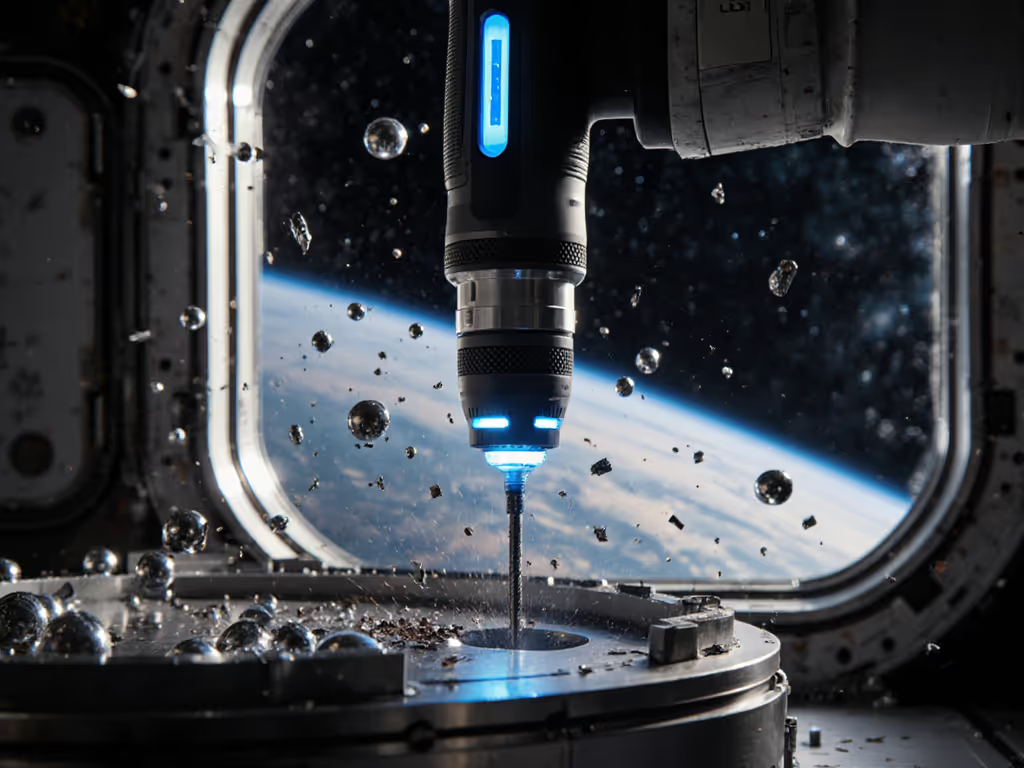
When NASA engineers set out to drill on asteroids and the Moon, they faced a problem that ground-based contractors and DIYers rarely consider: the drill doesn't weigh anything to push into the rock. Zero-gravity drill adaptations reveal a fundamental truth about tool design, when the environment changes, everything changes. Understanding how space tool engineering rethinks the basics offers insight into why conventional approaches fail under extreme constraints and what happens when designers must forget what "down" means.
Why Gravity Can't Be Taken for Granted
What makes zero-gravity drilling fundamentally different from Earth drilling?
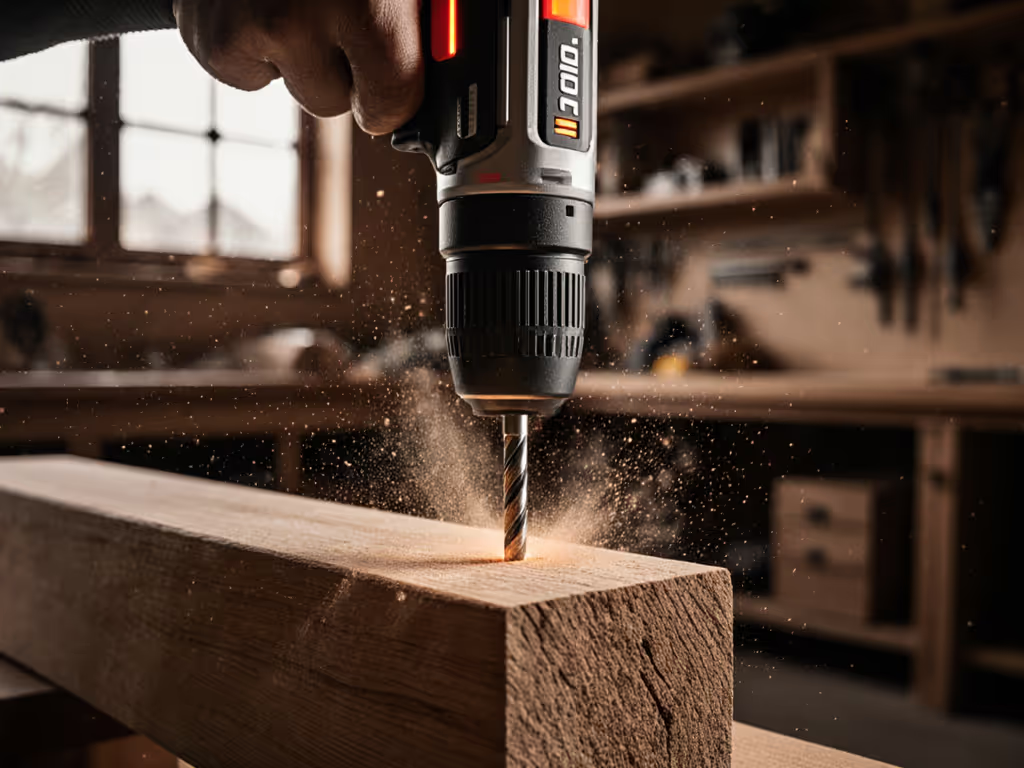
On Earth, gravity does half the work for you. When you press a drill against a screw or into wood, your weight (and the tool's weight) provides what engineers call weight-on-bit (the downward force that keeps the bit cutting). In zero gravity, that force vanishes. The drill floats. The astronaut floats. The rock doesn't cooperate.
Traditional rotary drills (the familiar design most builders know) rely on steady downward pressure and the bit's rotation to shear through material. Remove gravity, and the drill no longer has an anchor. It spins freely, the astronaut gets pushed backward by reaction force, and little progress happens. This is where microgravity drilling techniques diverge sharply from what works on Earth. See our NASA drill tech history for how space constraints shaped cordless design.
The principle echoes a lesson many DIYers discover the hard way. My neighbor once stripped a screw head on a bookshelf by pressing too hard and losing control (the opposite problem, but driven by the same root issue): mechanical advantage requires a stable setup. NASA engineers faced the same question: How do you create stability when the ground isn't there?
The Anchor Solution: Creating Stability from Scratch
How do engineers solve the weight-on-bit problem in space?
NASA's Microgravity Drill and Anchor System flips the conventional approach. Instead of relying on external force pushing downward, the drill carries its own anchoring mechanism (micro-spine feet that grip the rock surface and hold the drill steady during operation). The required downward force comes not from gravity but from the drill itself, a self-contained system.
This design allows the drill to maintain consistent cutting pressure in any orientation: upside down, sideways, on a cliff face, or inside a lava tube. The astronaut doesn't push the drill into the rock; the drill anchors itself and works. Reaction forces feed into the anchor system instead of into the astronaut's arm.
It's a reminder that the best tools don't always do the work for you, they create the conditions where work becomes possible. Start with the project, then match the drill and batteries, as the saying goes among seasoned tool users. In space, the "project" was sampling rock under impossible conditions, so the drill had to be radically reimagined.
Learning from Nature: Efficiency Under Constraints
Why would NASA engineers study insects and animals to design drills?
When conventional engineering hits a wall, nature has often already solved the problem, sometimes for millions of years. Researchers discovered that nature-inspired drilling methods dramatically reduce the overhead forces and energy demands needed in low-gravity environments.
The wood wasp's reciprocating drilling motion (a rapid back-and-forth pecking action combined with rotation) requires roughly 50% less top force than standard rotary drilling. A sandfish-inspired approach improves mobility through granular media (loose regolith on the Moon) by 40%, while clam-like fluidization methods reduce drag by 90%.
Double-reciprocating drilling prototypes have achieved penetration depths up to 2 meters while consuming only about 3 watts of power (critical for space missions where power is scarce). For context, most cordless drills on Earth draw 300-500 watts under load. The efficiency gap is staggering.
This principle translates to Earth-based tool design in subtle ways. Compact, forgiving tools that adapt their motion to the material (rather than forcing maximum torque) tend to build user confidence faster and suit a wider range of projects. For an engineering deep dive into motor efficiency and control, read brushless drill efficiency explained. That's not coincidence; it's elegant engineering under constraint.
The Role of Precision and Stability in Design
How does zero-gravity drilling demand different precision standards?
In space, every mistake is exponentially more expensive. A drill bit breaks or jams 240 million miles from Earth, and there's no quick trip to the hardware store. Spacecraft tool modifications must account for failure tolerance and self-correction in ways Earth tools often don't.
The rotary-percussive coring mechanism used by NASA's drill produces a 0.75-inch (1.9 cm) diameter hole while preserving a 0.5-inch (1.3 cm) rock core for analysis, a tight tolerance achieved through a combination of rotation and controlled percussion. The drill must not only cut but also capture samples without contamination or damage.
On Earth, a contractor or DIYer can adjust, retry, or replace a part mid-project. In space, the design has to anticipate challenges and build in safeguards before launch. That difference drives innovation: cleaner chuck design, more predictable bit behavior, feedback systems that sense resistance and adjust speed or percussion rate automatically. For practical examples of adaptive controls in today's tools, see smart drill features that reduce guesswork.
Adaptability Across Environments
What can we learn about tool design from adapting drills to extreme conditions?
One of the most impressive capabilities of NASA's microgravity drill is that it works in multiple orientations and on multiple surfaces (rock, ice, layered regolith) without recalibration. The anchor system maintains mechanical advantage regardless of angle, and the dual-action drilling method adjusts to different material resistance.
That principle (designing for adaptability rather than optimizing for a single scenario) mirrors the mindset of skilled tool users on Earth. A compact drill that handles both driving fasteners and drilling holes, that works overhead and in tight spaces, and that remains responsive whether the battery is fresh or partially depleted, serves more projects with fewer tool switches.
NASA engineering principles emphasize redundancy, fail-safes, and modular design so systems can be repaired or reconfigured with available parts. For small shops aiming for versatility, explore modular drill systems and how component swaps expand capability. Space tools are built to endure and adapt, not to be disposable or single-purpose.
Why Design Constraints Drive Innovation
What does zero-gravity drilling teach us about solving hard problems?
Every constraint eliminated from a design reveals a hidden assumption. When engineers removed gravity, they had to articulate every force that gravity had been providing for free. They discovered that weight-on-bit wasn't the only issue: reaction forces, stability, power efficiency, and precision all depended on Earth's gravity in subtle ways.
Once those dependencies were made explicit, designers could solve them individually: anchoring handles the downward force, percussion reduces cutting energy, modular design handles serviceability, and material science improves durability in temperature extremes. To handle heat loads that sabotage runtime and precision, learn how drill motor cooling affects sustained performance.
On Earth, we rarely face such absolute constraints. But the thought process (identifying what each part of a tool truly needs to do, separating necessity from habit) sharpens everyday design choices. A well-designed drill doesn't overcomplicate what the user is trying to accomplish; it removes obstacles and builds confidence through reliable, predictable behavior.
The Takeaway: Design Adapts When Environment Demands It
Zero-gravity drilling isn't a curiosity, it's a window into how engineers rethink fundamentals. By removing assumptions, adding precision, borrowing from nature, and building in adaptability, space tool design demonstrates that the best solutions often come not from adding power but from understanding constraints deeply.
For anyone choosing tools or tackling unfamiliar projects, that mindset applies. The project drives the pick: start by understanding what the environment and task truly demand, then find or design the tool that delivers exactly that, no more, no less. Confidence comes from the right setup, and the right setup always begins with honest assessment of the constraints you're facing.
Want to explore how these principles show up in next-generation extraterrestrial construction tools or discover more about spacecraft tool modifications in the research labs? The intersection of space engineering and Earth-based tool design continues to yield surprising insights into reliability, efficiency, and human-centered problem solving.
Related Articles