Drill Motors as Kinetic Art: Speed, Vibration & Control
By Linh Tran • 28th Apr
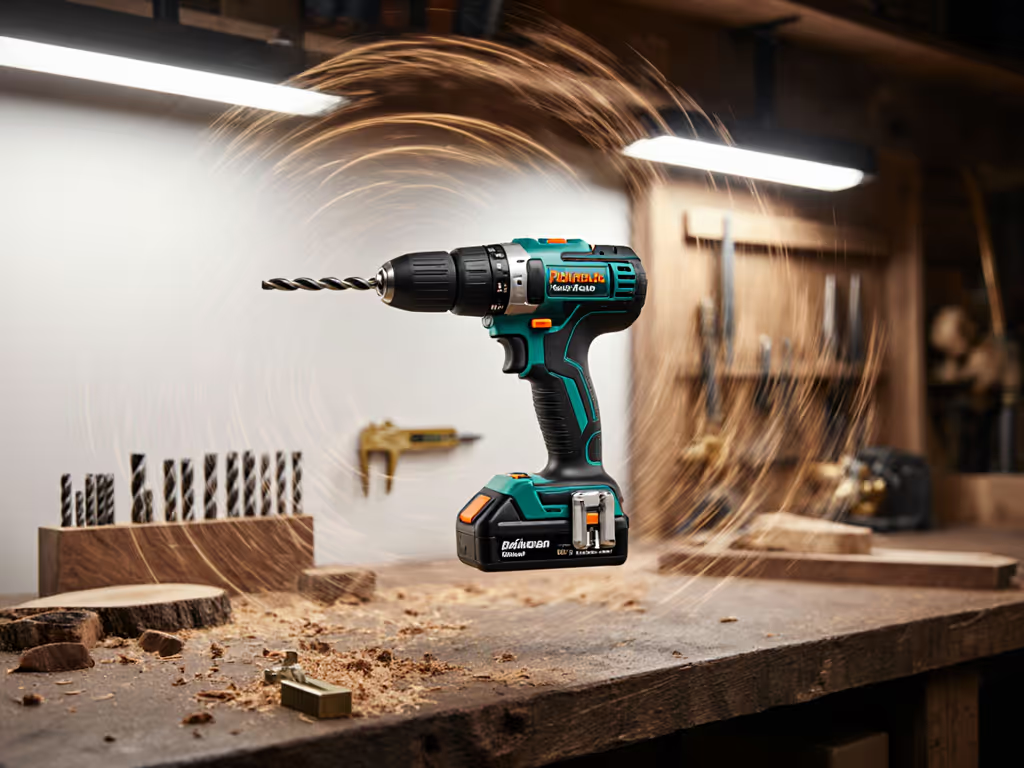
When artists and makers venture into kinetic art drill techniques, most start with a straightforward assumption: grab a motor, bolt it to a mechanism, and watch it spin. But that path diverges quickly. If you need a refresher on torque, RPM, and battery metrics, start with our drill specifications guide. The difference between a sculpture that mesmerizes for five years and one that seizes halfway through an opening is rarely flashy specs (it is the unglamorous reality of sustained torque, predictable RPM under load, and the mechanical cost of keeping motion alive). This article breaks down the true performance math behind moving sculpture tools, particularly drill motors and their gearbox companions, so you can build installations that do not become expensive paperweights.
The Problem: Specs Don't Predict Art
Drill motor specs tell you almost nothing about what matters in kinetic sculpture. A 20-volt drill rated at 1,500 RPM no-load tells you the motor's ceiling in a lab, not what happens when you attach a real load (a rotating wheel, a camshaft, a series of gears holding mechanical energy). The moment you couple a drill motor to your sculpture, several realities collide:
- RPM collapse under load: Motors bog down, and voltage sag eats your speed. A motor that spins freely at 1,500 RPM might limp along at 300 RPM the instant you load it with inertia and friction. Your beautiful rotating installation becomes a sluggish trudge.
- Vibration and harmonic failure: Unbalanced wheels, misaligned shafts, and inadequate bearing support create vibration that fatigues welds, loosens fasteners, and destroys bearings over weeks or months. What looked stable in the first week begins to wobble by week three. To mitigate these modes early, review measured results from modern vibration damping systems across major brands.
- Torque mismatch: Drill motors are optimized for percussive work (impact driver) or moderate continuous duty (drill). They are not load-holding machines. If your sculpture requires steady torque to resist backdriving (gravity pulling a hanging element, for example), the motor will stall or thermal-throttle.
- Thermal headroom: Continuous-duty motors in kinetic installations run for 8, 12, or 24 hours without rest. Most consumer drill motors throttle their output or shut down when core temperatures exceed ~80°C. In ambient heat or poor ventilation, that limits your run window severely.
The cost-per-minute math often fails silently. You buy a bargain-bin drill platform, pair it with a 4-RPM geared motor off Amazon, and for the first month (or three) it works. Then the bearings start grinding. The battery platform you chose no longer carries spares. The gearbox you saved fifty dollars on warps under sustained load, and your "affordable" installation becomes a costly rebuild cycle. Downtime is the tax you pay for treating the motor as interchangeable with its spec sheet.
The Agitation: Real-World Load Testing Reveals Hidden Costs
The kinetic art projects that endure share a trait: they were engineered, not assembled. Consider a typical scenario. A maker designs a rotating kinetic sculpture with two counter-rotating wheels cut from 1/8-inch and 1/4-inch Baltic birch, backed by a rubber-band drive belt[1]. The design calls for 10 RPM to make the pattern change visible without strobing. The builder sources a 4-RPM motor[1] and adds a simple gear ratio to hit target speed. So far, reasonable.
But then:
- The wheels were not perfectly balanced during laser cutting. Runout is 0.015 inches. At 10 RPM, that is barely noticeable; at higher sustained speeds, it is a rhythmic thump.
- The rubber-band drive has no load capacity model. After two weeks of continuous operation, it creeps and slips, dropping effective RPM by 1-2.
- The shaft tolerance was drilled with a 17/64-inch bit for a 1/4-inch shaft[1], leaving a loose fit. Over time, micro-vibrations work the wheel off-axis.
- The motor draws 0.8 amps continuous, or roughly 10 watt-hours per hour. A 2.0 Ah battery (standard in many drill platforms) dies after 12 hours. The builder installed just one charger. Downtime on the weekend (when foot traffic to the installation peaks) becomes routine.
This scenario is not hypothetical. It is the cost of skipping the total-ownership checklist. The true expense is not the motor or battery; it is the failed opening, the apology emails, and the scramble to source replacement parts. Evidence over hype means stress-testing your design before it becomes public art.
The Solution: A Risk-Adjusted Specification Framework
Building a kinetic installation with drill motor components demands no-nonsense clarity on five thresholds:
1. RPM and Gear Ratio
Target RPM for visible motion in kinetic sculpture is typically 5-15 RPM[5]. Faster (30+ RPM) risks strobing; slower feels dead. If you are using a drill motor, expect 70-1,500 RPM no-load, depending on the platform and motor type. A simple two-stage gear reduction (belt drive + internal gear, or planetary gearbox) is mandatory. Many DIY builders use a 4-RPM geared motor as a starting point[1], then validate actual speed under load with a tachometer. Do not estimate, measure.
2. Load Capacity and Torque Reserve
Calculate the resistant torque of your sculpture: weight of moving parts × radius (in inches) ÷ 12 = inch-pounds of load. Your motor must deliver at least 1.5× that torque to avoid stalling or thermal throttle. Most consumer drill motors deliver 300-600 inch-pounds at the chuck; coupled to a gearbox, that can translate to 20-100 foot-pounds at the output shaft, depending on ratio. But motor datasheets often hide the continuous duty rating. A motor rated for 600 inch-pounds at peak is typically good for only 200-300 inch-pounds sustained. This is your real threshold.
3. Bearing and Alignment Integrity
Shaft runout should be held to ±0.005 inches or tighter. This often requires a pillow-block bearing or a precision mandrel. Many DIY builds skip this, trusting a loose fit and the motor's internal bearing. After 500-1,000 hours of runtime, vibration fatigue shows up: loose fasteners, cracked welds, bearing wear. A $30 pillow-block bearing saves a $500 rebuild. Clear thresholds here: if you cannot measure runout or cannot access replacement bearings, redesign the load path.
4. Thermal and Electrical Duty Cycle
A drill motor rated for "intermittent duty" (typical for consumer platforms) can safely run 10-20 minutes per cycle, then cool for 30-40 minutes. If your installation is 24-hour continuous, you need a motor spec'd for continuous duty, or you need redundant motors with automatic switching. Thermal throttling is not a feature; it is a failure mode disguised as protection. For the engineering behind heat management and sustained output, see our drill motor cooling guide. Battery voltage sag is another silent killer. A 20-volt drill platform drops to 16-18 volts under load; at 15 volts, many motors lose 40% of their torque. If your gearbox requires steady input, this degradation will show as sluggish motion or stalling as the battery ages.
5. Downtime Cost and Platform Ecosystems
A single-charger, single-battery setup is a liability. Avoid bottlenecks with the right chargers and packs from our cordless drill battery kits guide. If your sculpture runs on a proprietary drill platform (say, an 18-volt ecosystem from one manufacturer) and a bearing fails, you need a replacement motor that fits that platform. Some manufacturers support that; others do not. Before committing to a motor source, audit the supply chain: Can you buy a replacement motor in two days? Is the battery ecosystem still in production in three years? Will a $150 repair kit be available, or are you buying a $400 new motor? Cheap upfront, expensive in downtime (value shows in charged minutes). Most professionals running field art installations standardize on platforms with clear TCO: known battery cost, wide third-party support, and sub-week lead times on parts.
Final Verdict: Evidence Over Hype
Drill motors are powerful components for kinetic art when deployed with discipline. The trap is treating them as plug-and-play components rather than precision mechanical systems. Your installation's success (measured in hours of reliable motion before failure) hinges on three non-negotiable practices:
- Measure actual RPM, torque, and thermal performance under load, not just nameplate specs.
- Design for 1.5-2× the anticipated load, so your motor has headroom and your installation has margin.
- Plan your battery and charging logistics as carefully as your mechanical design. A single-charger setup is a promise of failure.
For artists and makers who embrace this rigor, drill motor-based sculptures can run reliably for years. For those who skip the math and hope the specs work out, expect the third week to reveal costly surprises. The question is not whether a drill motor can power kinetic art (it can). The question is whether you will invest in the engineering discipline to make it sing or settle for the expensive lessons that come with shortcuts.
Related Articles