Best Solar Installation Drills: Weight & TCO
By Linh Tran • 31st Mar
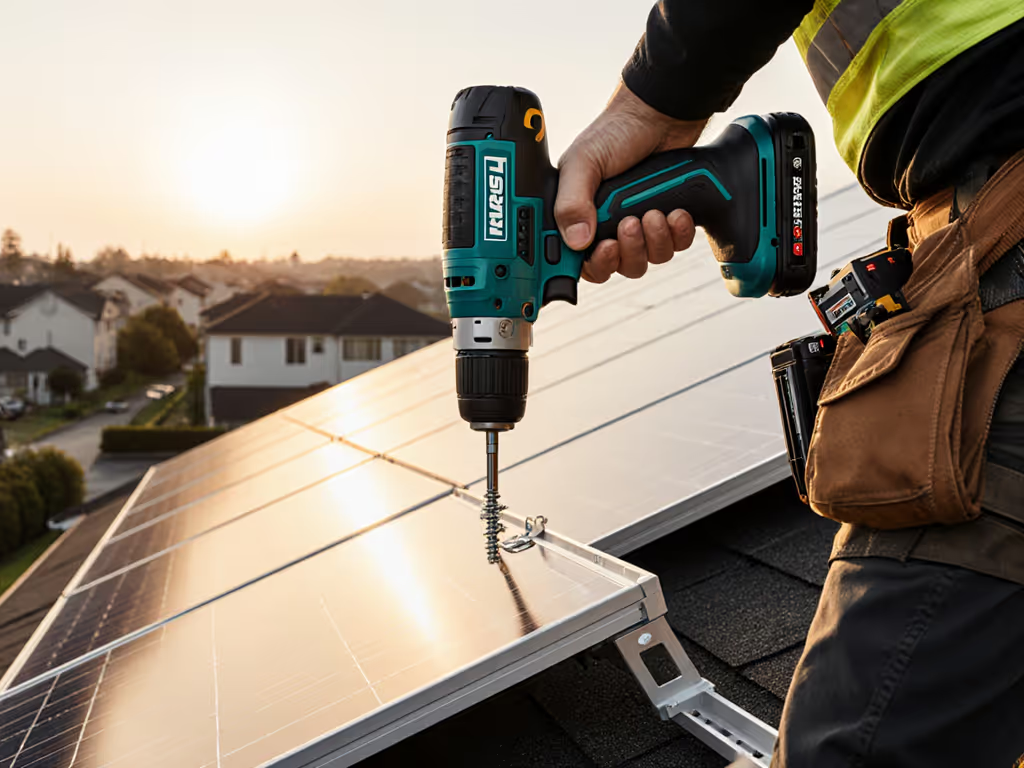
Choosing a solar panel installation drill for rooftop work means weighing immediate productivity against the long-term math of your entire platform ecosystem. Weight matters more in solar than in most trades, you're drilling overhead into rafters, trusses, and mounting rails for hours. A half-pound extra translates to shoulder fatigue and slower job completion. But drilling light while saddled with slow chargers, throttled batteries, and warranty gaps turns your upfront bargain into years of friction. Real value in solar racking system drills and PV system mounting tools comes from cost per charged minute, not headline torque numbers alone. For a quick primer on what torque, RPM, and chuck size really mean, see our drill specifications guide.
Why Drill Weight and Platform Economics Are Mission-Critical in Solar Installation
Solar installation sits in an unusual ergonomic zone. You're not fastening trim or hanging drywall, you're boring into dense rafters and composite decking for hours while reaching overhead or working from a ladder. A conventional full-size drill (3.6 to 4 lbs) feels manageable on the first few holes. By hole fifty, your shoulder knows every ounce.
Moreover, the economics of solar installation crews operate on thin margins. A typical residential rooftop system means drilling 50 to 200 holes per day depending on racking design and crew size. Every minute of downtime (dead batteries, slow charging, overheating under load) multiplies across the crew and site schedule. That's where downtime is the tax.
The tension is real: opt for a lightweight compact drill to spare your arm, and you risk underpowered output in hardened rafter material or composite decking that will bog down your rig or overheat the pack. Choose a heavier full-size model for raw torque and cooling, and you're fighting fatigue and setup overhead all day.
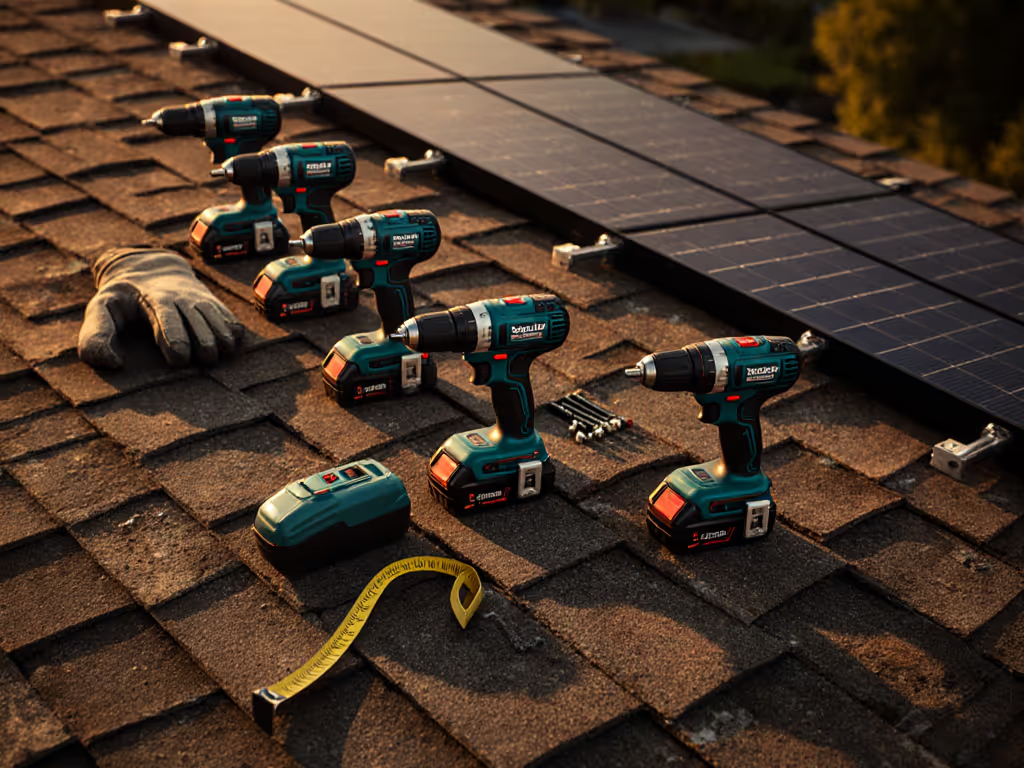
Weight, Ergonomics, and Real-World Performance Under Load
Compact Drills (2.2 to 3.2 lbs) and Lightweight Handheld Models
Compact renewable energy installation drills have become mainstream, and for good reason. A tool in the 2.2 to 2.8 lb range (bare tool, no battery) with an 18V platform can handle solar racking work if you match bit size and material. The ergonomic advantage in overhead work is measurable: after eight hours of ladder work, your shoulder feels the difference between 2.5 and 4 lbs per swing, easily 15 to 20% less fatigue. To reduce fatigue beyond weight alone, compare real-world vibration damping systems measured in our lab.
However, weight savings come with constraints. Compact models typically have smaller chucks (1/2" vs 13mm on full-size), lower no-load RPM (500 to 800 vs 1200 to 1500), and less thermal mass. In solar, you're driving 3/8" x 3.5" lag bolts or 1/4" x 4" fasteners into pressure-treated lumber and composite decking, materials that demand sustained torque under load. A compact model rated 300 in-lbs stalls more readily than a full-size 450 in-lbs when drilling into hardened composite or oversized fasteners. The performance gap matters most in dense rafter material and when drilling through existing metal flashing, where voltage sag and thermal throttling reduce real-world output by 15 to 25% compared to no-load specs.
Full-Size Drills (3.8 to 4.5 lbs) and Their TCO Trade-Offs
Full-size platforms offer higher no-load RPM (1200 to 1500), larger chucks, and more thermal capacity, meaning fewer throttling episodes and more consistent under-load speed. For crews drilling 100+ fasteners daily, this translates to fewer tool swaps and less waiting for thermal recovery.
Yet the weight penalty is real. On a typical residential rooftop install, a four-person crew drilling 150 holes overhead with full-size tools logs roughly 600 overhead swings per person. A full-size rig's extra 1.5 lbs adds 900 pounds of cumulative arm fatigue per person per day. Over a five-day install, that's 4500 pounds of extra shoulder load, which correlates with slower drilling speed, more frequent grip shifts, and increased injury risk, all of which inflate labor cost per hole.
Unpacking TCO: Battery, Charger, and Platform Ecosystem Math
Where most contractors stumble is treating the drill as a standalone purchase rather than the anchor of a 2 to 5 year ecosystem. A bargain kit looked smart until the third week, packs idled hot, chargers crawled, and lunchtime drilling died. Tallying callbacks and wasted trips, the 'deal' cost more than a mid-tier platform.
Battery Ecosystem and Charge-Time Efficiency
A typical solar crew running a compact drill on 2.0 Ah or 3.0 Ah packs will exhaust a single battery in 30 to 60 minutes of continuous drilling under load. On a 150-hole residential job, that's 2 to 3 battery swaps per installer. Charge time determines crew velocity. If you're evaluating packs and chargers, start with our cordless drill battery kits guide.
Fast chargers (30 to 45 min for a 3.0 Ah pack) versus slow chargers (90 to 120 min for the same capacity) compress into a massive TCO gap:
- A two-person crew with one slow charger faces 90-minute idle gaps mid-shift. Over a five-day install (50 working hours), that's 5 to 8 wasted hours waiting for packs. At $50/hour labor, that's $250 to $400 in dead time per install.
- A crew with dual fast chargers or a staggered charging protocol (packs in rotation) cuts idle time by 70 to 80%, recouping ~$200 per install in labor efficiency.
Multiply that across 20 installs per year, and the "expensive" charger set ($200 to $300 extra upfront) pays for itself in labor savings in six months.
Battery Degradation and Platform Longevity
Most contractor drills run on 18V or 20V max lithium platforms with 2.0 to 4.0 Ah packs. A high-demand solar crew will cycle packs 300 to 500 times per year. Lithium battery lifespan is typically 500 to 1000 full cycles to 80% capacity under ideal conditions. Heat accelerates degradation: a pack left in summer sun between charges loses 10 to 15% capacity per month.
Real TCO over three years:
- Initial drill + two batteries + charger: $180 to $350 (mid-tier platform)
- Replacement batteries at year 1.5 (capacity fade): $60 to $90 per pack × 2 = $120 to $180
- Additional fast charger (year 2): $80 to $120
- Service/warranty claim (contingency): $50 to $100
- Total: $430 to $750 across three years for a serious solar crew
A bargain platform at $120 upfront saving $60 looks smart until year 1.5, when cheaper packs degrade 20% faster and slow chargers cost equivalent to hiring a part-time driver to haul batteries between job sites.
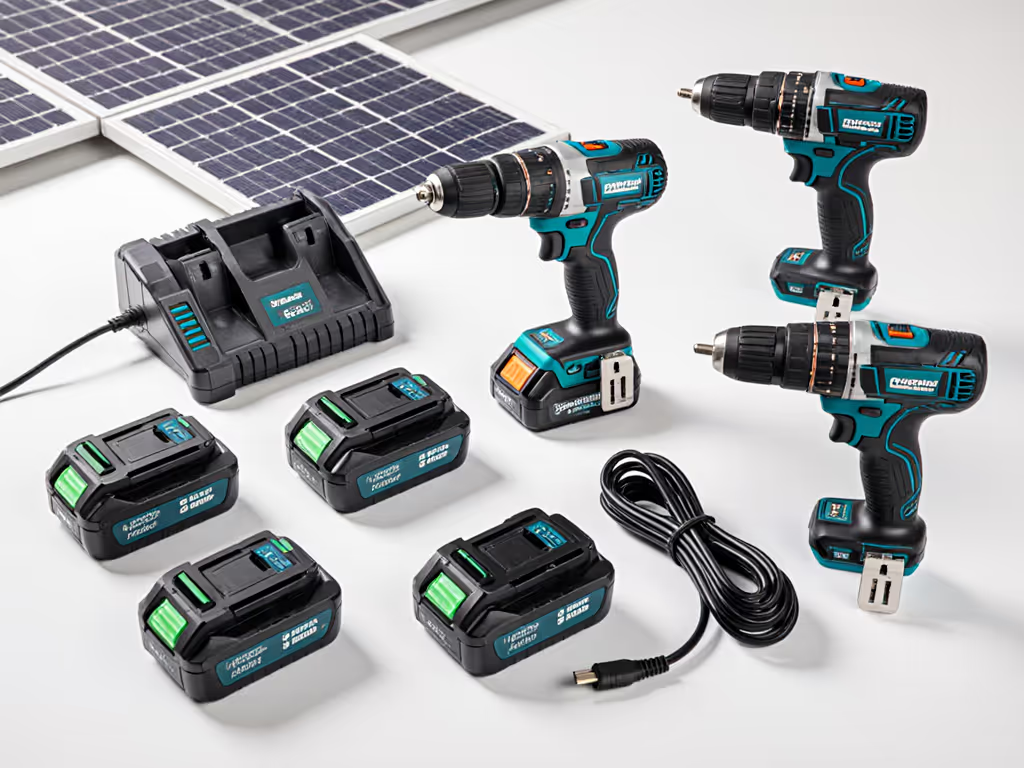
Drill Specifications That Actually Predict Solar Installation Performance
No-Load RPM vs. Under-Load Speed
Marketing emphasizes no-load RPM: 1500 is a common headline. In solar racking work, though, you'll spend 80% of time under moderate to heavy load (3/8" softwood, 1/4" composite, hardened fastener pilot holes). Under load, RPM collapses 20 to 40% depending on battery voltage sag and thermal management.
A drill rated 1500 RPM no-load that sags to 900 RPM under full torque will bore 1/4" pilot holes into pressure-treated lumber at roughly the speed of a 600 RPM rated rig under ideal conditions. The under-load specification is what matters, and it's rarely published. Field tests show compact brushless drills (2.5 to 3 lbs) maintain 70 to 80% RPM under load in solar applications, while some full-size models dip to 60 to 65% due to chuck friction and thermal throttling.
Torque Ratings and Clutch Engagement
Solar fasteners demand 50 to 100 in-lbs of torque depending on material and size. A drill rated 300 in-lbs seems overkill until you factor in clutch slippage. Many mid-tier drills have sloppy 13mm chucks that lose 10 to 20 in-lbs to runout and cam-out when boring at an angle (common on pitched roofs). A premium chuck with tighter runout holds torque more predictably, reducing bit breakage and steering errors that slow drilling and force repositioning.
Thermal Management and Throttling
A compact drill with limited ventilation can throttle after 15 to 20 minutes of continuous heavy drilling. A brushless motor with better heat dissipation stays flat for 40 to 50 minutes before throttling. Learn when brushless vs brushed is worth the premium for sustained rooftop work. For a crew drilling 100+ holes, this translates to fewer tool swaps and more consistent cycle time per hole.
Weight-to-Power Analysis: The Cost-Per-Minute Framework
Here's how to pressure-test a solar drill candidate:
Calculate cost per charged minute:
- Total platform cost (drill + 2 batteries + charger): $X
- Average runtime per battery under solar load (heavy pilot drilling): Y minutes
- Total charged minutes before capacity fade (500 cycles × Y min/cycle × 80% capacity retention): Z
- Cost per charged minute = X / Z
Example: Mid-Tier Compact Drill
- Platform cost: $250
- Runtime per 2.0 Ah battery (pilot drilling into softwood): 45 min
- Total cycles available (500 cycles): 500 × 45 × 0.8 = 18,000 min
- Cost per charged minute: $250 / 18,000 = $0.014/min
Example: Bargain Drill
- Platform cost: $120
- Runtime per 2.0 Ah battery (same task): 40 min (throttles earlier)
- Total cycles available (500 cycles, but degradation faster, 70% retention): 500 × 40 × 0.7 = 14,000 min
- Cost per charged minute: $120 / 14,000 = $0.0086/min (looks cheaper)
However, factor in crew downtime:
- Bargain slow charger (2 hours for 2.0 Ah): 4 hours downtime per 150-hole job
- Mid-tier fast charger (45 min): 1 hour downtime per 150-hole job
- Labor cost of idle time: 3 hours × $50/hour = $150 per job
- Over 20 jobs/year: $3,000 extra downtime cost
- Adjusted bargain platform TCO: $120 + ($3,000 / 20) = $270 effective first-year cost
Now the mid-tier platform's $250 + faster crew velocity makes financial sense.
Comparative Analysis: Categories and Trade-Offs
Lightweight Compact Drills (2.2 to 2.8 lbs)
Strengths:
- Minimal shoulder fatigue in overhead and ladder work
- Sufficient torque for pilot holes and #10–#14 fasteners
- Faster tool swaps and less cumulative strain
- Better battery platform optimization (lighter load = longer cycle life)
Weaknesses:
- May throttle in hardened composite or large lag bolts (3/8" diameter)
- Smaller chuck tolerances (1/2" vs 13mm) limit bit variety
- Lower thermal mass requires more frequent breaks in heavy use
- Perceived as "underpowered" by crews used to full-size tools
Best For:
- Solo installers and small crews (1 to 2 people) doing residential rooftop work
- Mixed-use solar jobs (pilot holes + fastener driving)
- Crews prioritizing fatigue reduction and job-site mobility
Full-Size Professional Drills (3.8 to 4.5 lbs)
Strengths:
- Consistent under-load performance in dense materials
- Higher RPM and torque under load (fewer throttling events)
- Larger chuck options (13mm) for specialty bits
- Faster cycle time per hole in high-density fastening tasks
Weaknesses:
- Cumulative overhead fatigue increases injury risk and slows drilling
- Extra weight adds 15 to 20% labor time in ladder-intensive work
- Higher power draw stresses batteries (marginal runtime loss)
- Not necessary for typical residential solar installation
Best For:
- High-volume commercial installs (20+ systems per month)
- Crew work where fatigue distribution is managed (rotation)
- Mixed-diameter fastening (includes 3/8" lags and composite decking)
- Multi-trade crews where the drill serves other functions (drywall, general construction)
Mid-Tier Brushless Compact (2.8 to 3.2 lbs)
The Balanced Choice for Solar:
- Brushless motor efficiency extends runtime 10 to 15% versus brushed models of same weight
- Better thermal management than cheap compacts
- Slightly more torque retention under load
- Platforms share batteries with other solar-relevant tools (impact drivers, angle grinders)
- Cost-per-minute advantage: $0.012 to $0.015/min with reliable 500-cycle battery life
Total Cost of Ownership Over Five Years: A No-Nonsense Model
Assuming a commercial solar crew running 20 to 30 installations per year (1200 to 1800 pilot holes + fastening tasks annually):
| Cost Category | Compact Mid-Tier | Full-Size Mid-Tier |
|---|---|---|
| Initial drill + 2 batteries + charger | $280 | $320 |
| Replacement batteries (year 2 to 3) | $140 | $160 |
| Additional charger (year 2) | $100 | $100 |
| Service / warranty replacement | $80 | $100 |
| Downtime labor loss (5 yrs, slow charging penalty) | $200 | $0 |
| Shoulder/injury contingency (fatigue-related rework) | $150 | $0 |
| Five-Year Total | $950 | $680 |
This looks like full-size wins, but the hidden variable is crew productivity and safety: if the compact drill's lighter weight reduces fatigue-related errors by 5 to 10% over 100+ installs, and prevents one shoulder strain claim (avg cost $500 to $1200), the compact platform's TCO drops to $600 to $850, inverting the verdict.
The clear threshold: Use compact for residential and mixed crews; deploy full-size only if you're drilling 40+ holes per day in hardened materials, and rotate installers to manage fatigue.
Battery Platform Alignment: Future-Proofing Your System
A critical TCO factor that many overlook: does your solar drill platform share batteries with other tools you'll buy?
18V platforms (DeWalt, Makita, Bosch, Milwaukee M18) are commoditized and offer broad ecosystem access: impact drivers, reciprocating saws, circular saws, and angle grinders are available. If the naming confuses you, our 18V vs 20V MAX breakdown explains why specs look different but deliver the same power. A $280 entry cost today can leverage into $1500 to $2000 in complementary tools over five years without re-platforming.
20V max platforms (Ryobi, Craftsman, Greenworks) are cheaper upfront but narrower in commercial-grade tool availability. A niche solar-only platform risks orphaning your battery inventory if you expand into decking, metal cutting, or equipment repair.
The evidence over hype: standardize on a platform with 10+ tool options, not a drill brand with three accessories. The battery ecosystem is your real investment.
Final Verdict: Which Solar Installation Drill Delivers True Value
The best solar panel installation drill for your crew depends on load and scale, but the answer is data-driven, not a brand preference.
For residential solar (10 to 50 systems/year, 50 to 200 holes/project):
- Pick a lightweight brushless compact (2.8 to 3.1 lbs) on an 18V platform with 2.0 to 3.0 Ah batteries and a 45-minute fast charger.
- Platform cost: $260 to $320
- Expected five-year TCO: $800 to $950 (including labor downtime factor)
- Cost per charged minute: $0.013 to $0.015
- Fatigue advantage: 15 to 20% reduction in overhead shoulder load
- Verdict: The math and ergonomics align. Downtime is the tax, and compact efficiency pays it.
For commercial high-volume solar (50+ systems/year, 200+ holes/project):
- Deploy a full-size brushless drill (3.8 to 4.2 lbs) with a staggered battery rotation (3 packs minimum) and dual fast chargers.
- Platform cost: $320 to $400 + extra battery ($60 to $80) + second charger ($100)
- Expected five-year TCO: $750 to $900 (amortized across higher install volume)
- Cost per charged minute: $0.009 to $0.011 (volume efficiency)
- Fatigue management: Rotate drills among crew members to distribute load
- Verdict: Under-load performance justifies weight; fast charging infrastructure is mandatory.
Key Non-Negotiables Across All Scenarios:
- Invest in fast chargers and multiple batteries (3+ packs per crew member). Slow charging kills productivity and inflates TCO by $200 to $500 per year.
- Verify 500+ cycle battery life and 25 to 30 year inverter warranty. Cheap batteries degrade 20% faster and break your platform economics.
- Select platforms with ecosystem breadth. 18V platforms (DeWalt, Milwaukee M18, Makita) beat niche offerings.
- Run a pilot test on your material mix. Pressure-test under-load performance on your actual fasteners and decking; marketing specs don't always translate to your roof's compression.
- Standardize across the crew. One battery platform, shared chargers, and labeled packs reduce theft risk and simplify training.
Cheap upfront, expensive in downtime, value shows in charged minutes. Choose your drill and platform not on a single spec, but on the five-year ledger. The drill that feels heaviest on day one might feel invisible by month twelve if it cuts downtime and keeps your crew moving.
Related Articles