
Modular Drill Conversion: Real Speed & Performance Data
By Jordan Reyes • 7th Mar
What Is a Modular Drill System Comparison Really About?
A modular drill system comparison isn't about counting attachment options - it's about whether switching tool heads faster than swapping entire drills translates to measurable productivity gains and realistic runtime across your actual workload. Unlike traditional drills, modular platforms let you change working heads while keeping the same motor unit, but the job-site math depends on how often you're converting, how quickly you recover under load, and whether tool versatility actually reduces the total battery drain that determines how many holes per charge you can actually bore before needing the charger. For a broader perspective on head types, interface design, and when modularity actually pays off, see our modular power drill systems guide.
The real question pros and serious DIYers face: does convertible power tool flexibility save enough time and cost to justify the initial investment, or does it just add complexity and require more batteries on site?
Why Does Task-Switching Speed Matter Under Load?
Faster tool changes - measured in seconds between bit or head swaps - only matter if you're not burning down battery capacity during the changeover itself. When I field-test modular platforms against the traditional multi-tool approach, the metric that separates real gains from marketing noise is drill conversion efficiency: the time saved by faster attachment changes divided by the additional energy cost of maintaining a powered motor and battery connection between tasks.
Traditional drills force you to power down, swap the entire tool, and restart. Modular systems keep the motor warm and ready. But on a typical residential framing day (mixing driving fasteners, drilling pilot holes, and boring larger clearance holes), the clock savings are real only if your platform doesn't throttle under the load variation. A drill that maintains stable under-load speed when switching between a small spade bit and a heavy auger is worth the modular premium; one that bogs down and forces you to wait for voltage recovery isn't.
A comparative study of drilling operations confirms that tool speed stability during load transitions directly impacts holes per charge and shift completion[5]. When one drill maintains RPM consistency through material changes and another doesn't, the difference in completed work per battery swap often exceeds 20% - a fact that ends specification arguments once you measure it, not read it.
How Do Modular Drills Actually Reduce Downtime?
Downtime in the modular drill context means time your crew isn't driving fasteners or enlarging holes. The sources of downtime are:
- Swapping between tool functions (drilling vs. driving vs. angle access)
- Waiting for thermal recovery after heavy tasks
- Changing batteries and hunting for the charger
- Repositioning yourself because the tool is too bulky for the workspace
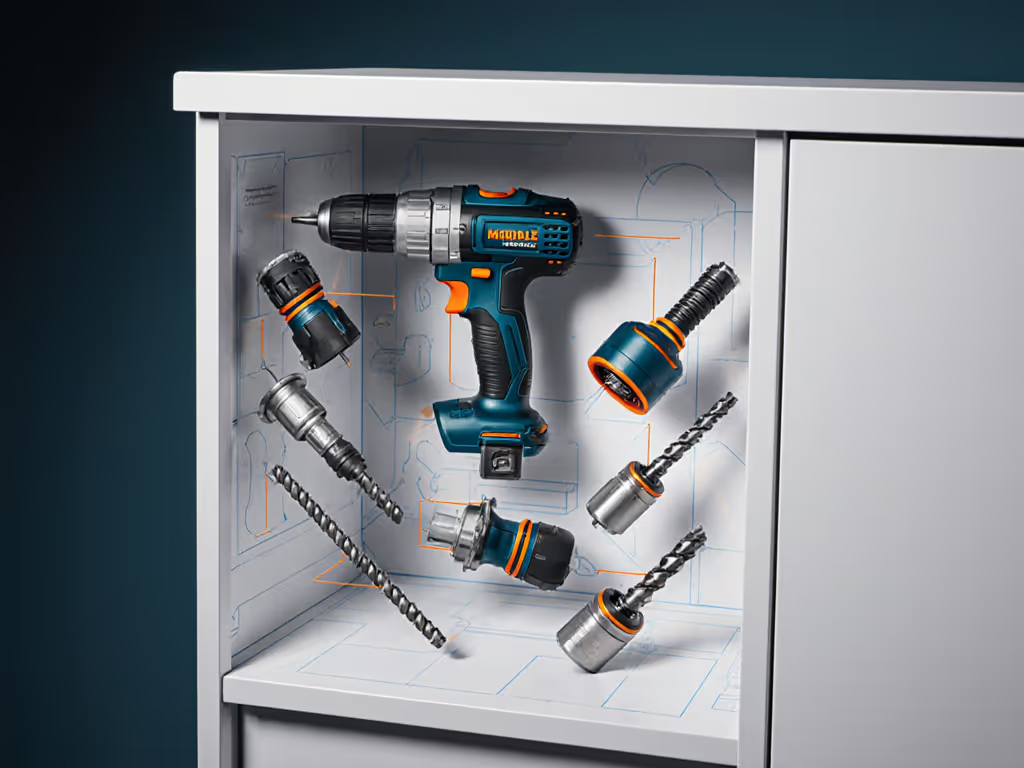
Modular platforms tackle the first and partially the third. Attached right-angle heads eliminate the need to reposition your whole body when drilling inside cabinets or between joists - that's real fatigue savings, not speculation[1][2]. Tool changes without stopping work means if you're on a ladder fastening trim, you swap a Phillips bit to a spade bit without climbing down or cradling the drill while fumbling; the motor keeps running, your grip never loosens.
However, modular efficiency breaks down if the platform requires excessive battery swaps. A small-capacity battery that forces you back to the charger every 45 minutes negates the speed gains from faster head changes. The key is matching motor demand to realistic battery sizing, one of the least transparent metrics in manufacturer specs. For sizing help and runtime planning, compare battery kits and charging options that match your load profile.
What Performance Metrics Actually Predict Job Outcomes?
Manufacturer drill specifications - peak torque, no-load RPM, voltage - don't predict whether a modular drill finishes a job or grinds to a halt. Here are the metrics that do:
Under-Load Speed Stability: RPM sag during heavy tasks (large bits, dense materials, full battery load) measured in real time. A drill rated 1,500 no-load RPM that drops to 800 RPM under a 1/2-inch auger in hardwood is a different tool than one that holds 1,300 RPM under identical load. That stability difference translates directly to holes per charge.
Speed Deviation Across Materials: Drilling cortical bone versus cancellous bone (or plywood versus hardwood) requires constant bit-load adjustment. Orthopedic drilling research shows that drills with poor speed control exhibit deviation exceeding 6% across material transitions, while stable designs stay below 0.1%[3]. On a full day's work - framing, cabinets, fastening - this compounds into 15-30 minute time gaps.
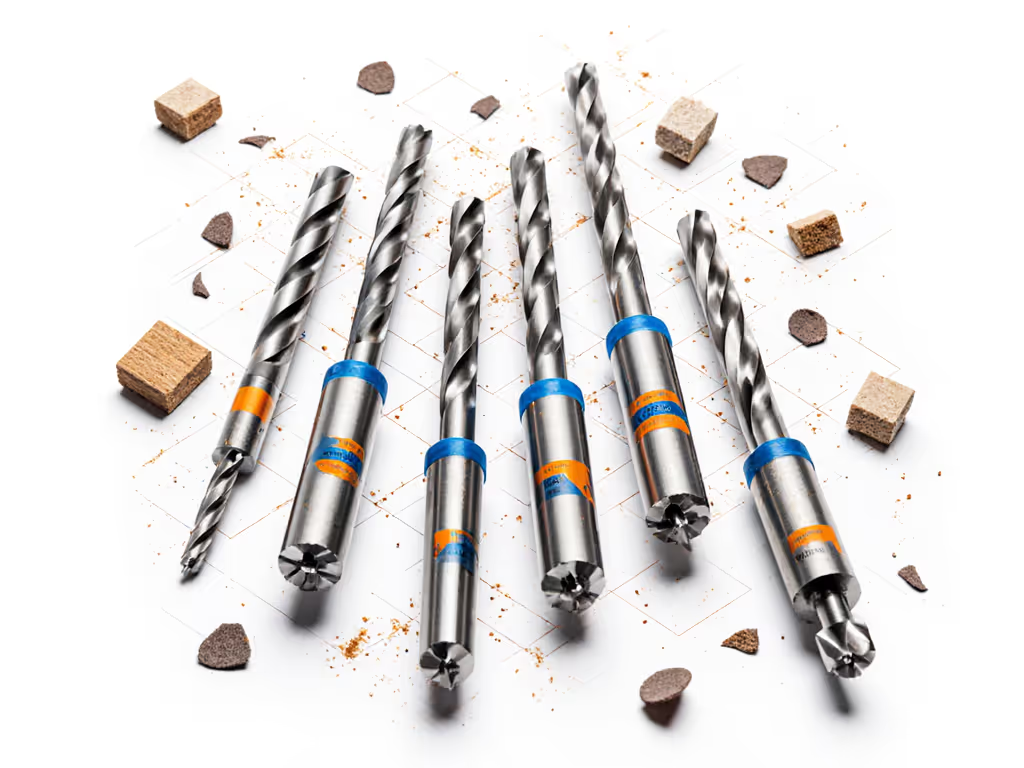
Thrust Force Consistency: Heavier, stable thrust from the motor means cleaner holes and fewer stalled bits. Modular systems with reinforced quick-change interfaces show better torque transfer than traditional chucks, reducing wobble and runout, measurable via straightness deviation and surface finish, not torque alone[1].
Holes Per Charge by Bit Size: This is your actual work capacity. A 20V modular system might deliver 150 3/8-inch holes on one battery but only 40 1-inch holes. Manufacturers rarely break this down; you must test or ask users who've logged it. Supporting keywords like multi-function drill evaluation often hide the fact that versatility can reduce efficiency per function.
How Does Modular Platform Flexibility Change Total Cost?
Initial investment is higher for modular systems. A modern modular platform - motor unit, battery, charger, and 3-4 interchangeable heads - often costs 40-60% more than a basic traditional drill-driver combo. But the real cost curve favors modular systems over 2-5 years:
Traditional Approach: You buy a drill, a driver, a right-angle adapter (if you remember), and eventually a heavy-duty impact driver. Total tools: 4. Total batteries needed for 8-hour crew work: 6-8 (because different tools drain at different rates, and you need redundancy). Total chargers: 2. After three years, battery replacement costs mount; each battery is a $40-$80 SKU tied to one tool.
Modular Approach: One motor unit, 5-6 interchangeable heads, 3-4 batteries that work across every head. Total chargers: 2. If a head wears out, you replace only the $20-$35 wear item, not a $150 tool. After three years, you've invested more upfront but spent less on redundant hardware and replacements.
The cost advantage deepens if your team standardizes on one battery platform. Charging logistics simplify, tool training becomes universal, and lost-tool replacement is less catastrophic - you swap a head, not a whole unit[2][4]. For contractors managing 3+ crew members, platform standardization often saves enough on chargers and battery duplication to justify the modular premium within 18 months.
Do Modular Drills Actually Perform Better Under Real Load?
Not universally - it depends on the platform. Modular systems can excel or fail depending on:
Quick-Change Interface Quality: A poorly designed modular connection introduces runout and play, degrading accuracy and requiring more corrective force from the user. Better interfaces mean better torque transfer and more consistent bit alignment[1].
Motor Tuning for Varied Heads: A motor optimized for lightweight screwdriving bits may not perform well when you swap to a heavy spade bit. True modular platforms use adaptive torque curves (sensor feedback on load) to maintain speed stability across head types. Cheaper modular systems often don't, forcing you to manually throttle and adjust.
Thermal Management: Keeping the same motor spinning across multiple rapid task switches generates heat differently than a single-function tool. If the motor or battery can't dissipate that heat, performance throttles after 20-30 minutes. For the engineering behind heat dissipation and sustained performance, see drill motor cooling explained. Test this by measuring speed sag and recovery time after continuous varied-load work, not just single-function runs.
A comparison of drilling operations confirms that consistent platform performance requires attention to load stability, vibration control, and speed feedback[5]. Platforms that skip this tuning feel versatile but underperform each individual function.
Is Tool Versatility Worth the Ecosystem Lock-In?
This is where ecosystem anxiety surfaces most. Choosing a modular platform means committing to that brand's battery connector, charger standard, and future head lineup. Before you commit, compare cross-brand ecosystem value to understand platform trade-offs. If Manufacturer A discontinues their 18V modular line in four years, you're left with orphaned batteries and limited future attachment options.
The tradeoff is real. Traditional multi-tool purchasing lets you mix brands - Makita drill, DeWalt driver, Milwaukee impact - spreading your bets. Modular systems bet everything on one brand's continued commitment to that platform.
For serious DIYers and small crews, this risk is manageable if you choose a brand with long-term modular investment (established industrial drills, leading battery platforms). For solo DIYers, the flexibility upside may not justify the ecosystem bet, unless you're certain you'll use at least 4-5 different heads over five years. If you'll bore 80% spade bits and 20% screws, a traditional combo is rational; if your work mix is balanced across 6+ functions, modular efficiency compounds.
What Questions Should You Ask Before Choosing Modular?
What's your actual annual hours of drilling and driving, split by workload type (fastening, boring, angle access)? If it's under 100 hours per year split across many task types, the versatility plays. If it's 500 hours of mostly one function, single-purpose tools may be faster and cheaper.
What's the average battery rundown on your most common task? If a battery drains in 45 minutes of heavy boring, you need at least three batteries. Modular platforms only save money if you're buying fewer batteries total, not more.
How tight is your typical working space? Right-angle modular heads solve real access problems in cabinet interiors and stud bays. If most of your work is open, this advantage shrinks.
What's your platform's support lifespan? Has the manufacturer committed to parts availability and compatibility for 5+ years? Or is the line being phased out in 2-3 years?
Are your crew or family members already invested in a battery platform? Standardizing on a single ecosystem beats owning three incompatible systems.
The Verdict: Under-Load Speed Wins the Comparison
Modular drill system comparison comes down to honest answers about your workload, space constraints, and growth path. Modular platforms shine when under-load speed is stable across tool changes, when battery capacity matches your task duration, and when your work genuinely spans enough functions to justify platform ecosystem commitment. They falter when marketed on versatility alone, without confirming that each head actually performs as well as its single-purpose equivalent under sustained load.
The honest metric: modular drills aren't universally faster or cheaper. They're smarter if your real work pattern justifies them. Test before you commit. Borrow or rent a modular system for a full job, not a demo run. Measure holes per charge, thermal sag after switching between heads, and whether faster attachments actually translate to faster task completion for your type of work.
That's where spec sheets end and your next platform decision begins.
What's Next?
If modular systems align with your workflow, dive deeper into platform-specific tests: compare holes per charge by bit size and material, verify quick-change interface runout with test bits, and ask users with 2+ years of runtime whether the initial investment paid off. If you're still fence-sitting, map your workload against single-function alternatives and calculate total cost of ownership including batteries, chargers, and replacement heads. The right answer is never the flashiest one. It's the one that honestly predicts your job-site reality.
Related Articles