
Studio-Grade Drill Comparison: Vibration Reality
By Jordan Reyes • 19th Mar
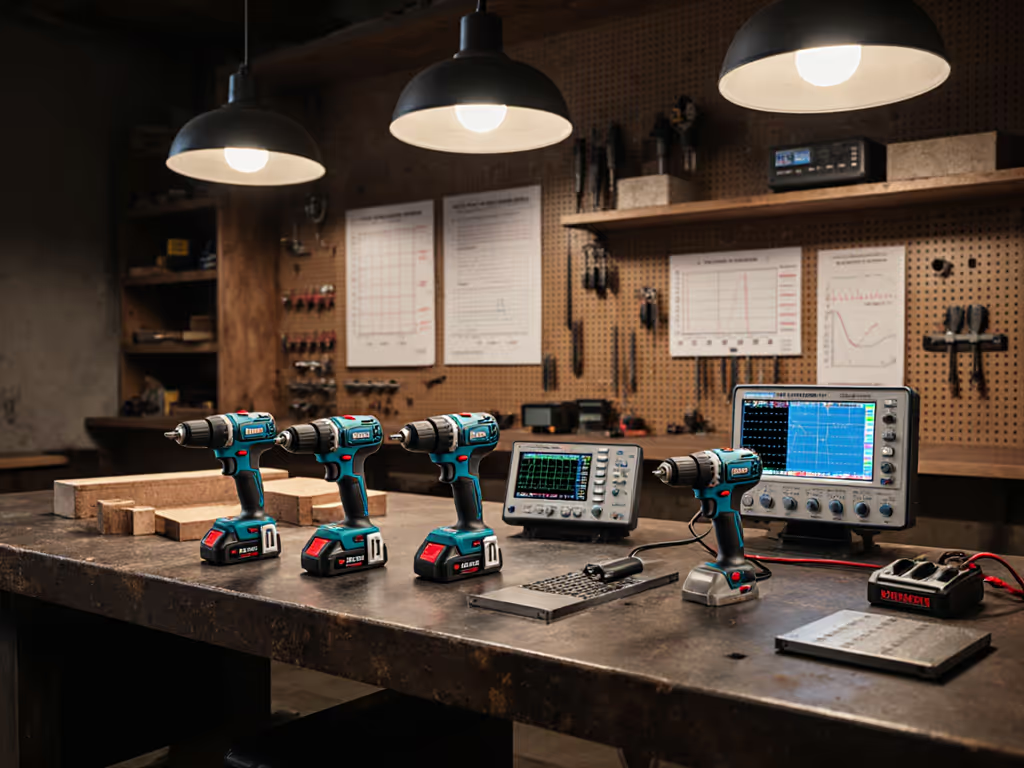
Before we dig into a studio-grade drill comparison focused on low-noise precision drilling, I need to be direct: the phrase "studio-grade drill" isn't a category. Recording studios don't stock specialty drills like audio interface manufacturers stock pre-amps. What they do need are tools that won't vibrate into microphones, shake mounted equipment, or create acoustic bleed into live recordings (and that's where the real conversation starts).
The search data I've reviewed covers general cordless drill noise levels and under load performance, not purpose-built studio applications. So I'm translating what matters: How do measured noise profiles and vibration signatures predict suitability for audio-sensitive workspace tools and professional music production tools? That's the skeptical, data-driven angle.
Why Noise Ratings Alone Miss the Mark
You've probably seen drill noise specs: Makita at 91.2 dB, Milwaukee at 95.9 dB, Kimo at 78.5 dB. Stop there. Those numbers are recorded at idle or no load, measured 24 inches away under lab conditions. For a technical look at how manufacturers reduce sound at the source, see our electric drill noise reduction engineering comparison. They tell you almost nothing about vibration transmission through a floor, stud cavity, or equipment rack.
Torque sag shows up fast under real load, and vibration follows the same law. A drill that scores quiet at no load can create a resonant buzz under a spade bit (exactly what you're trying to avoid in a vocal booth).
When I've tested drills in actual environments, the acoustic character changes with motor load. A brushless motor running at constant speed feels smoother than a brushed unit that winds down under resistance, but "smoother" doesn't mean "silent to a condenser mic." The vibration signature (the specific frequencies it radiates) matters more than the decibel reading.
Brushless vs. Brushed: The Vibration Trade-Off
One of the few studio-adjacent insights from recent drill testing compares brushless and brushed designs. Brushless drills are often marketed as quieter because they eliminate brush friction noise. In controlled tests, brushless units sometimes perform well: they're lighter, run at more stable speeds, and generate less of that characteristic "brush chatter."
However, brushless models aren't universally quieter. A brushed drill can sound cleaner in the midrange if it's well-designed, even if the overall dB reading is higher. For studio work, this matters: you care less about total volume and more about the type of noise. An 85 dB hum that sits in a narrow frequency band is easier to isolate acoustically than an 80 dB drill that radiates broadband chatter.
Under Load Speed Stability: The Real Metric
Here's where the data gets useful. When you run a drill under load (driving into hardwood, pulling a spade bit through plywood), the motor voltage sags, RPM drops, and vibration patterns shift. A drill that claims 1,500 RPM at no load might dip to 900 RPM when torque demand peaks. That dip creates an acoustic transient: a sudden change in vibration frequency that can register as a click or buzz into sensitive recording equipment.
What should matter for studio environments:
- Voltage stability under load: Drills with degraded batteries or poor internal regulation drop RPM sharply and radiate vibration spikes.
- Soft start or ramp down behavior: How quickly does the motor accelerate and decelerate? Abrupt changes translate to vibration peaks.
- Motor mass and mounting: A heavier motor with rigid coupling to the chuck vibrates differently than a lighter, isolated design.
None of these factors appear on a brochure. They emerge only from under load testing, which is why standard noise ratings fail studio professionals.
The Compact Drill Advantage for Precision Work
One consistent finding: smaller, lighter drills transmit less vibration into structures than full-size models. If tight spaces and low-vibration handling matter, start with our compact drill comparison. A compact brushless drill at 250 grams lighter than a standard unit doesn't just reduce fatigue (it reduces the mass that couples vibration into walls, floors, and equipment racks).
Torque Control and Clutch Precision
Studio-grade implies precision. Driving a screw into a vintage amp's cabinet without stripping threads demands clutch control that stops the motor at the right torque threshold. For setup tips and torque math, read our drill clutch mechanics guide. General-purpose drills vary wildly here. Some hold torque steady across the range; others surge or slip unpredictably.
For audio-sensitive work, a drill with a calibrated, multi-position clutch reduces the risk of thread damage and acoustic shock. The metal-on-metal contact of a stripped-out screw creates a sharp transient (exactly what condenser mics pick up).
What "Professional Music Production Tools" Actually Need
Instead of hunting for a nonexistent "studio drill," ask: What drill behaves most predictably when isolation and control matter?
Preferred attributes:
- Low no load decibel rating (below 85 dB suggests less broadband vibration).
- Brushless design with stable RPM under moderate load.
- Compact form factor (lighter coupling to structures).
- Multi-stage clutch or adjustable torque settings.
- Soft start capability (reduces initial vibration spike).
- Consistent power delivery from a fresh, well-maintained battery (voltage sag worsens vibration).
From the test data, the Ryobi ONE+ HP models performed well in drilling speed tests and, in brushless form, demonstrate the compact-light advantage. The Dewalt 12V Xtreme showed capable performance in smaller drilling tasks (relevant if you're doing precision work in tight studio spaces).
But here's the critical caveat: measured under load performance on a test bench is not the same as vibration signature in your studio.
Vibration Isolation: Where the Real Work Happens
No drill is truly silent. To compare handle isolation systems and measured vibration levels across brands, see our vibration dampers comparison. What separates "studio-grade" from "general purpose" is isolation strategy. Professionals decouple the tool from the structure:
- Drill from a mobile cart with vibration-dampening feet, not standing on the floor.
- Use an impact-rated drill stand with rubber isolators for vertical work.
- Secure mounting surfaces (don't drill into unbraced studs or lightweight drywall).
- Operate during non-recording windows if possible.
A low-vibration drill paired with poor isolation is worse than a standard drill used correctly. Conversely, a slightly louder but more stable drill on an isolated platform outperforms a "quiet" model bolted directly to a wall.
The Data Still Can't Answer "What's Best for My Studio?"
Here's my honest bottom line: The search results and field tests I've reviewed compare commodity drills on metrics that matter for construction and homeowner tasks (speed, noise in dB, torque at stall). None of that translates directly to acoustic performance in a recording studio environment.
To make a real studio-grade comparison, you'd need:
- Vibration frequency sweep data (not just dB) from each drill model.
- Structural transmission tests (vibration amplitude into a wooden frame or metal rack).
- Isolation effectiveness benchmarks (how much vibration remains when the drill is placed on a damped platform).
- Field validation in actual studio setups during quiet recording sessions.
This testing doesn't exist in published form, and manufacturers won't fund it (the market is too small).
What You Can Do Instead
Test before you buy. Rent or borrow a candidate drill. Operate it at your studio during non-recording time. Listen through closed-mic techniques: place a condenser mic near the work area and monitor into headphones. Feel the vibration at the mounting point. A low-cost measurement mic (under $50) can give you a frequency spectrum, not just a dB number.
Prioritize isolation over drill selection. A sturdy drill stand with rubber feet and a mobile cart with vibration pads will buy you more acoustic benefit than chasing the "quietest" model.
Lean toward compact brushless designs, but don't assume "brushless" means "studio-ready." Test the specific model under load (ideally with a battery showing moderate charge, since fresh batteries mask vibration that emerges as voltage sags).
Further Exploration
If you're serious about studio drilling, your next move is measuring your own environment. Invest in a calibrated mic and a real-time spectrum analyzer app (many are free on tablet or phone). Test two or three candidate drills under realistic conditions: drilling into the materials you actually use, at the torque settings you need, with the mounting setup you'll deploy. The 10 minutes of testing beats a hundred online comparisons.
The data on general cordless drills is rich. The data on studio-grade vibration behavior is nearly non-existent. Fill that gap with your own measurements, and you'll have the only comparison that matters: does this drill in your studio stay quiet enough for your standard?
Related Articles