
EMI-Shielded Drill Comparison: Server Room Reality
By Amina Okafor • 20th Apr
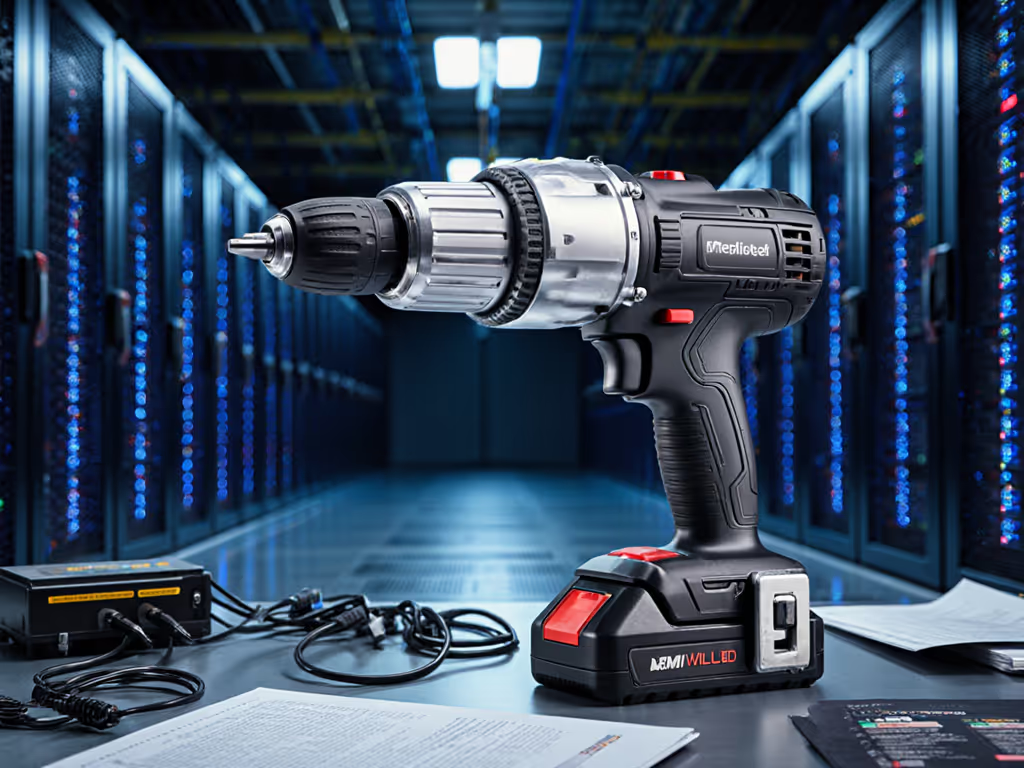
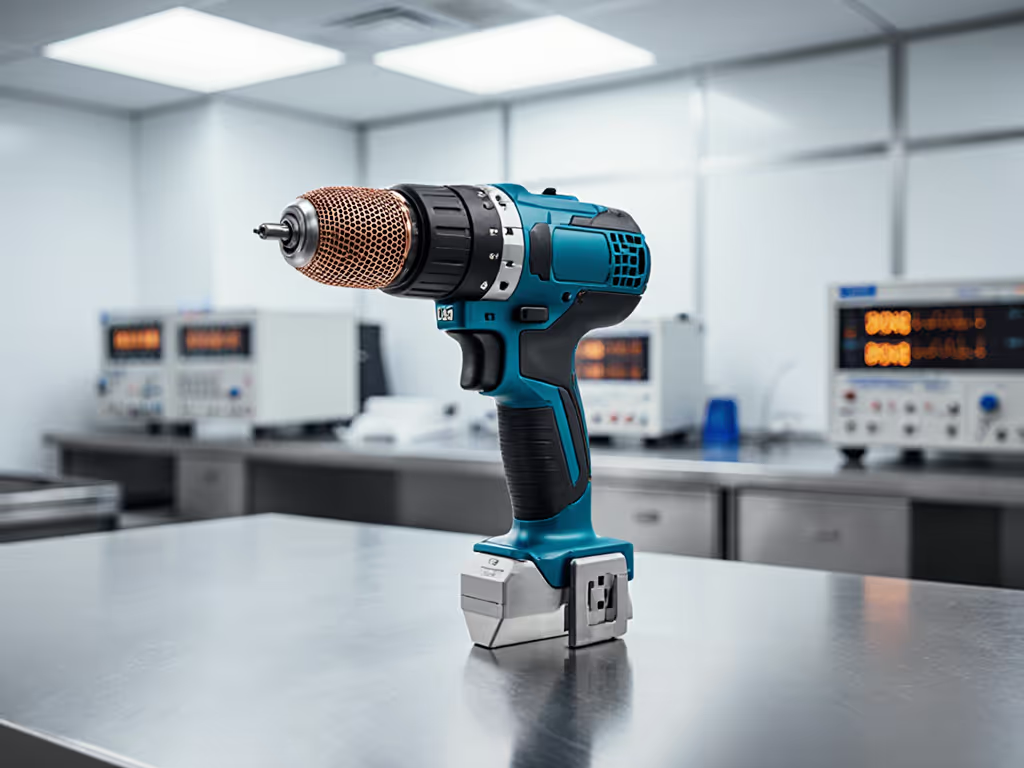
When you're drilling in or near a server room, EMI-shielded drill comparison and data center drilling tools aren't luxury considerations: they're operational safeguards. Electromagnetic interference from standard power tools can corrupt network traffic, trigger false alarms on sensitive monitoring equipment, or force unscheduled downtime. Yet most crews I work with don't evaluate drills on shielding performance; they pick the cheapest tool that has a cordless battery, then scramble when radio frequency emissions spike during a cabinet retrofit.
I'm going to walk you through how to compare low-EMI drill performance against actual server room requirements, so you can standardize the right tool across your facilities maintenance playbook. This isn't theoretical, it's the logic I use when planning multi-crew jobs where every workflow decision cascades into either risk or uptime.
1. Understand What EMI Shielding Effectiveness Really Measures
Shielding effectiveness is quantified in decibels (dB), which expresses the ratio between electromagnetic field strength with and without shielding[1]. A 40 dB reduction means 100 times less field strength reaching sensitive electronics; 80 dB means 10,000 times less; 120 dB means 1 million times less[5]. For server room drilling, you're typically looking for tools claiming 80-100 dB effectiveness across the frequency ranges used by network equipment (roughly 100 MHz to 2 GHz for Ethernet and wireless)[2][9]. For hands-on techniques to minimize interference near sensitive equipment, see our EMI control while drilling guide.
Why this matters operationally: A drill rated at 30 dB shielding (least effective category) can emit enough RF noise to trigger network monitoring alerts and require site IT to validate that no data corruption occurred[1]. A tool at 100 dB operates nearly invisibly to the infrastructure. When you're billing hourly labor to a facilities manager who's accountable for uptime, the difference between "tool caused a spike and we had to verify integrity" and "tool ran cleanly" translates directly to schedule compression or risk mitigation credit. Most standardized server room power tools spec 80-100 dB; if a vendor claims higher, ask which standard they're using.
2. Recognize the Three Military and Commercial Standards That Define Acceptable Performance
Three standards dominate shielding validation[1]:
- ASTM D4935: Measures shielding on flat materials across 30 MHz to 1.5 GHz using a comparative method (test material against a reference). This covers most commercial drills and battery packs.
- MIL-DTL-83528: U.S. DoD standard for elastomeric shielding gaskets. If a drill's battery compartment or connector uses mil-spec gaskets, expect higher consistency across temperature and humidity swings, relevant for data centers with strict environmental controls.
- MIL-STD-461: Another DoD standard targeting smaller electronic enclosures (like drill motors and circuit boards). Equipment meeting this is typically more robust against military-grade EMI exposure, a hint that shielding is engineered, not incidental.
Practical takeaway: A drill marketed as "DoD-tested" or "mil-spec gaskets" has undergone third-party validation. A drill with no cited standard has typically been tested in-house using unverified methods. When comparing electrical safety drilling tools for facilities, require vendors to cite the standard and provide test reports. This is non-negotiable for regulated environments (healthcare, government, financial).
3. Recognize Frequency Range Matters as Much as Peak dB Rating
Shielding effectiveness isn't uniform across frequencies[1][4][5]. A drill might achieve 100 dB at 1 GHz but only 60 dB at 100 MHz. For network installation drills, the critical range is 100 MHz-2 GHz (covering Ethernet, WiFi 5/6, cellular networks, and radios). Some older drills or budget models spec performance only in the higher ranges (> 500 MHz) where shielding is easier to achieve; there are gaps at lower frequencies where many network protocols operate.
Operational consideration: When standardizing a fleet of drills for multi-site facilities work, get spec sheets showing attenuation across the full 100 MHz-2 GHz band. If a vendor only graphs 500 MHz-2 GHz, ask why. To make sense of torque, RPM, and other numbers when reviewing datasheets, use our drill specifications guide. Incomplete frequency coverage is often a red flag that shielding was designed to pass marketing claims, not real-world server room conditions.
4. Material Conductivity Determines Shielding Durability and Consistency
EMI shielding in drills comes from conductive particles (usually silver, nickel, or graphite) embedded in elastomeric gaskets around the motor and battery[3]. Silver is "extremely conductive" with volume resistivity of 0.0009 ohms/cm; nickel-graphite is "conductive" at 0.01; carbon black is "semi-conductive" at 8.0[3].
Why this matters: Higher conductivity means more stable shielding performance over the drill's lifetime. Silver-filled gaskets maintain consistent attenuation even as the tool ages, gets used in dusty sites, or experiences thermal cycling. Carbon-black gaskets degrade faster. For a single job, the difference is negligible. For a facilities maintenance program where drills cycle through 10+ sites per year over 3-5 years, the choice between "super conductive" (silver-aluminum at higher cost) and "semi-conductive" (carbon black at lower cost) becomes a total cost of ownership calculation. Cheaper gaskets fail sooner; you replace them or retire the tool earlier.
Workflow consideration: Standardizing on one EMI-shielded drill comparison baseline (same model/shielding class across all crews) means consistent performance and simpler troubleshooting. Three crews running mixed brands with different filler materials? You're chasing intermittent RF noise problems that waste hours tracking which tool caused the event.
5. Understand Thickness, Material, and Frequency Tradeoffs
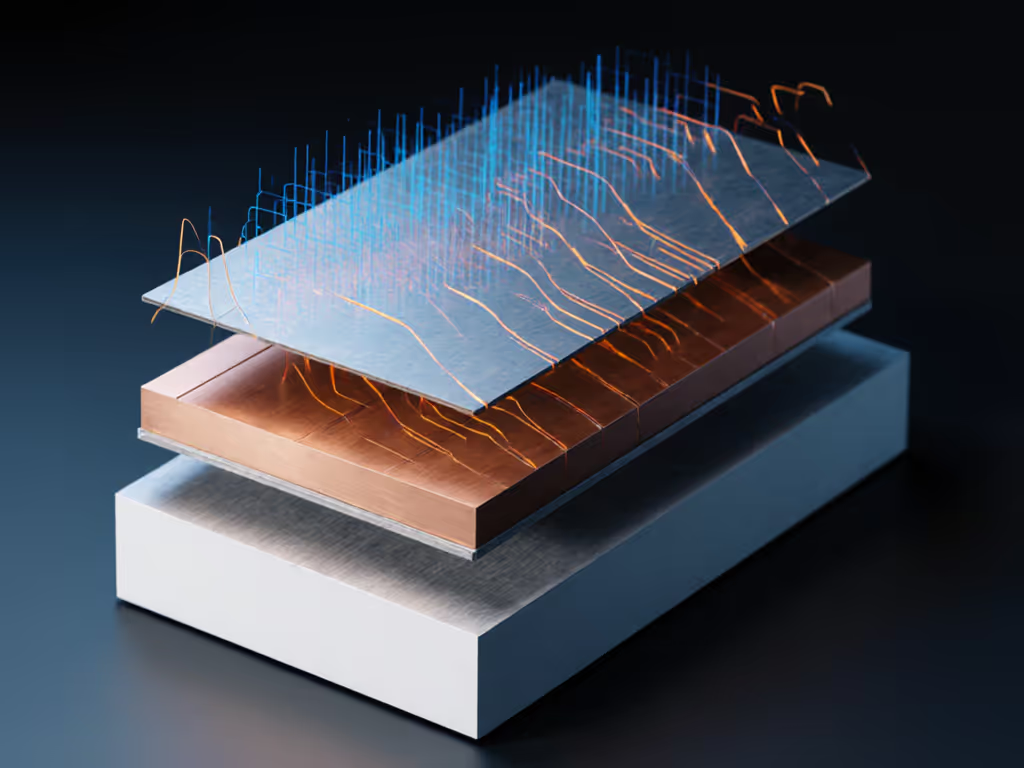
Shielding thickness must scale with frequency[5]. Low frequencies (10 kHz, magnetic fields) require thick material (6 mm mild steel for 80 dB attenuation); high frequencies (30 MHz) only need thin material (0.03 mm copper foil for comparable attenuation). For data center drilling tools, the drill motor itself is the noise source, and that energy spans multiple frequency bands. Manufacturers use layered shielding: a thin, highly conductive inner layer for high frequencies and a thicker, medium-conductivity outer layer for lower frequencies.
Practical reality: A drill claiming "full-band 100 dB performance" has multi-layer shielding that adds weight and complexity. A drill claiming "80 dB with optimized geometry" might achieve the same effective attenuation through smart material placement rather than brute thickness. Both are valid; the question is whether the added weight (and cost) justifies the marginal gain for your use case.
6. Recognize Grounding and Connector Management Seal the Deal
High shielding effectiveness on paper only works if the enclosure is properly grounded and connectors are filtered[4]. A drill with 100 dB shielding around the motor but loose battery contacts will emit RF through the connector as effectively as an unshielded tool. Similarly, if a conductor (like a charger cable) penetrates a shielded enclosure without being filtered at the entry point, it becomes an antenna that carries noise inside and outside[4].
Operational implication: When comparing low-EMI drill performance, ask the vendor: How are battery contacts sealed? Does the charger cable use filtered connectors? Are there service bulletins on proper grounding? A drill that's been engineered for shielding from the ground up (grounded chassis, filtered connectors, sealed battery compartments) will be more reliable in high-RF environments than a drill with peripheral shielding added to a standard design.
7. Plan Battery Platform and Charging Logistics Like Infrastructure Inventory
Here's where workflow and EMI intersect: Shielded drills often come from platforms that also offer shielded impact drivers, circular saws, and reciprocating saws. A facilities maintenance crew in a data center needs multiple tools, but standardizing on one battery platform (e.g., all 18V, all same connector) means one set of chargers, one spare battery rotation, and no mid-shift tool swaps that cause downtime.
I once ran three crews retrofitting a school. We standardized on one platform for all drilling and fastening work, placed two fast-chargers near the job site, and rotated battery inventory like material logistics. By week two, we'd cut eight lost hours from the weekly tally, no scrambling for a charged battery, no mixed-battery confusion, no "whose drill is this?" delays. That's when I realized: batteries are a workflow, not accessories (plan them like materials).
For server room work, the same logic applies. If you're choosing a platform to standardize on, start with our cordless drill ecosystem comparison. One shielded-drill platform, two to three spare batteries, one strategically placed charger outside the cabinet space. When a crew is drilling through multiple cabinet mounts, the battery isn't the bottleneck, but a mixed fleet (different discharge curves, different connector types, different shielding standards) absolutely is. Charger placement is policy: position it where crews stage tools, not where it's convenient for storage.
8. Validate Real-World Performance Under Load
Spec sheets show no-load RPM and stall torque. Real server room drilling (through steel racks, wood backing plates, concrete anchors) demands sustained power delivery under load. Many drills exhibit voltage sag (the battery's voltage drops as current demand peaks), causing the drill to slow or thermal-throttle[4]. For how thermal design impacts sustained performance and throttle behavior, see drill motor cooling explained. A drill rated 500 RPM no-load might deliver only 300 RPM when boring through 5/8" steel. Over a full shift, that rpm loss multiplies downtime across dozens of holes.
Comparison strategy: For network installation drills, test two or three finalist models on actual server cabinet materials and fasteners you'll encounter. Measure real-world hole time (minutes per hole, accounting for bit changes and material variety). A drill 5-10% faster no-load might be 20% slower under typical load. Field-validated performance beats spec-sheet claims every time.
9. Factor TCO: Batteries, Chargers, Replacements, and Standardization
A shielded-drill platform costs more upfront than a bargain tool, but the TCO over three years favors standardization. To factor coverage and turnaround into TCO, see our power tool warranty comparison. Bargain fleets require multiple chargers (each brand different), higher replacement rates due to tool loss or mixed-battery confusion, and more training overhead. Standardized platforms consolidate chargers, reduce downtime from battery/tool shuffles, and create predictable refresh cycles.
For a three-person crew working 240 days per year:
-
Bargain mixed fleet: $89-$129 per drill × 3 units = $267-$387 upfront; add 3-4 different chargers at $49-$99 each = $147-$396; annual replacement/loss at 15-20%; annual downtime cost (6-12 lost hours at $60/hr labor) = $360-$720. Three-year total: $1,400-$2,100.
-
Standardized EMI platform: $179-$249 per drill × 3 units = $537-$747 upfront; 1-2 universal chargers at $149-$199 each = $149-$398; replacement/loss at <5%; annual downtime cost (1-2 hours at $60/hr) = $60-$120. Three-year total: $1,100-$1,500.
The standardized fleet often costs less to operate, because charger placement is policy, batteries live in one rotation, and crews don't waste time troubleshooting "this drill feels slower than yesterday's".
10. Document Shielding Specs in Your Facilities Playbook
When you standardize on a data center drilling tools platform, document which tools meet which standards, what their shielding effectiveness is across frequency bands, and which chargers/battery combos you've validated. Create a simple checklist: "Before drilling within 10 feet of a network rack, verify the drill is on the approved list and battery is < 3 months old (within calibration)."
This sounds like bureaucracy, but it's risk management. When an RF event occurs, you have evidence that your teams used compliant tools. When you onboard a new contractor or rotate crews, they pull the same playbook, no retraining, no drift. Server room work is too high-stakes for informal standards.
Final Thought: Standardization Is a Platform Decision, Not a Tool Decision
EMI-shielded drill comparison isn't really about which drill has the prettiest finish or most marketing hype. It's about whether you're treating your tool ecosystem as a logistics system, batteries planned like materials, chargers positioned for uptime, crews trained on one standard, or chasing deals and hoping it works out.
Server rooms and data centers have zero tolerance for interference. Facilities managers protect their reputation on uptime. When you're evaluating platforms, ask: Which one lets me standardize charging, battery rotation, and training across all my crews? Which one has the longest track record in high-RF environments? Which charger strategy lets me place hardware where my teams actually stage work?
Those answers will tell you whether a platform is ready for server room reality or just another bargain bet. Start your platform research by requesting shielding reports for the frequency ranges relevant to your sites, then plan your battery and charger logistics around the winner. That's how you turn an EMI-shielded drill from a one-off purchase into an operations decision that pays back in reduced downtime, predictable performance, and peace of mind.
Related Articles